

Home » Why choose Smith » Understanding the Total Cost of Ownership (TCO) of oxyfuel equipment
Understanding the Total Cost of Ownership (TCO) of oxyfuel equipment
Total Cost of Ownership (TCO) of oxyfuel is a holistic way to measure the real economic impact of owning a torch, regulator, and related gear over its entire life.
When purchasing oxyfuel equipment, many buyers look only at the initial price tag—but that’s the smallest part of the cost equation.

In this article
Takeaways
The real cost of oxyfuel equipment includes not just the purchase price but also maintenance, downtime, replacements, and safety risks. It emphasizes that engineers and production managers should evaluate TCO to make smarter, safer, and more economical equipment decisions.
Using 10- and 20-year comparisons, the article shows that while Smith oxyfuel systems may cost more initially, their exceptional reliability, longer lifespan, and minimal downtime make them up to 67% more economical over time. Smith’s 25-year parts-and-labor warranty underscores its superior durability and engineering quality.
Ultimately, the article positions Smith as the global leader in economic value for oxyfuel equipment. Its lower TCO, higher uptime, and proven safety performance make it the smartest long-term investment for cutting, heating, welding, and brazing operations.
What “Total Cost of Ownership” Really Means
TCO = Initial Cost + Operating Costs + Maintenance + Downtime + Replacements − Resale/Residual Value.
For oxyfuel systems, the main contributors are:
| Cost Category | Examples |
|---|---|
| Purchase | Torch handle, cutting attachment, regulators, hoses |
| Consumables & Maintenance | Tips, O-rings, flashback arrestors, cleaning, service labor |
| Downtime | Idle labor, halted production, delayed projects |
| Replacement | New equipment when old fails or wears prematurely |
| Safety Incidents | Fire, flashback, property damage, injury, insurance impact |
| Training & Familiarization | Setup and calibration per brand |
A low-price torch may appear attractive, but once you include failures, replacements, and safety interruptions, its TCO skyrockets. Conversely, a durable, reliable system like Smith amortizes its higher purchase cost over decades of uninterrupted service.
Why to choose Smith
Here you will find compelling reasons to make Smith your preferred brand of oxy-fuel equipment:
Why Engineers & Production Managers Should Care About TCO
There are many reasons, even beyond financial ones, to be concerned about the total cost of ownership when it comes to oxyfuel.
Safety and Compliance
Engineering and safety departments carry liability for the safe gas systems operations. Reliable oxyfuel equipment reduces:
- Flashback probability
- Gas leaks and regulator creep
- Pressure instability that can compromise cut quality
Each avoided incident saves thousands of potential repairs, audits, and lost days.
Productivity and Uptime
Downtime costs exceed equipment costs. A single torch failure can stall multiple stations or a full production cell. Reliable tools directly protect throughput and delivery schedules.
Budget Predictability
Stable TCO helps plant managers plan capital expenditures. With Smith’s 25-year parts & labor coverage on core torches and attachments, asset lifespans are known and replacement cycles predictable.
ESG and Sustainability
Durable equipment lowers waste, packaging, and logistics footprints. A 25-year torch replaced every quarter century emits far less embodied carbon than three or four cheaper torches per decade.
The Real Economics of Reliability
Reliability is not only about knowing that your oxyfuel equipment will work smoothly whenever you need it but also includes an economic advantage.
The Hidden Costs of Cheap Oxyfuel Gear
- Frequent Failures: Low-tolerance valves, poor alloys, and inferior seals deteriorate rapidly.
- Creeping Regulators: Pressure drift leads to inconsistent flames and wasted gas.
- Increased Maintenance: Frequent tips and valve replacements.
- Downtime: Every unplanned halt multiplies cost via idle labor and missed production.
- Safety Risk: The cheaper the construction, the higher the leak or flashback potential.
How Reliability Converts to Dollars
Reliability → Fewer repairs → Higher uptime → More output → Lower cost per part.
Durability → Longer asset life → Fewer purchases → Lower capex amortized per year.
Both drive TCO down—precisely why Smith has become the global benchmark.
Smith’s Engineering Advantage
Smith, a brand of Miller Electric, builds oxyfuel equipment for industrial duty cycles measured in decades.
| Component | Warranty Coverage | Practical Service Life |
|---|---|---|
| Torch Handles & Cutting Attachments | 25 Years – Parts & Labor | 15–25 years typical |
| Straight & Machine Torches | 25 Years | 15–25 years |
| Major Regulators (Series 22, 30, 32, 35, 36, 40, 46, etc.) | 3 Years – Parts & Labor | 5–7 years |
| Specialty Regulators (Series 250, 820, etc.) | 2 Years – Parts & Labor | 4–6 years |
| Gas Axe Torches & Other Products | 1 Year – Parts & Labor | 3–5 years |
| Corrosive-Service Regulators | 90 Days | Highly variable |
The warranty clock begins at delivery to the end-user, not distributor’s receipt—a rare, user-friendly clause.
Smith excludes only normal-wear consumables (tips, O-rings, etc.), emphasizing its confidence in the core assemblies.
Ten-Year TCO Comparison
Let’s model a medium-duty fabrication shop operating eight hours a day, five days a week.
| Parameter | Smith System | Emerging Low-Cost Brand |
|---|---|---|
| Torch Handle + Attachment | $600 | $350 |
| Regulator Set (O₂ + Fuel) | $250 | $150 |
| Average Annual Maintenance | $20 | $40 |
| Torch Life | 25 yrs warranty → no replacement in 10 yrs | 3 yrs → replace at years 3 & 6 & 9 |
| Regulator Life | 5 yrs → replace once at year 5 | 2 yrs → replace at 2, 4, 6, 8, 10 |
| Downtime Events (per 10 yrs) | 1 × 2 hrs @ $150/hr = $300 | 5 × 2 hrs @ $150/hr = $1,500 |
10-Year Cost Calculation
Smith:
- Purchase = $850
- Maintenance = $200
- Replacements = $0 (torch) + $250 (regs) = $250
- Downtime = $300
- TCO = $1,600
Low-Cost Brand:
- Purchase = $500
- Maintenance = $400
- Replacements = 3 × $350 + 5 × $150 = $1,950
- Downtime = $1,500
- TCO = $4,350
Result: Smith saves $2,750 (≈63%) over 10 years—even though it costs more initially.
Twenty-Year TCO Projection
Extending the same logic doubles the gap.
| Parameter | Smith System | Low-Cost Brand |
|---|---|---|
| Initial Purchase | $850 | $500 |
| Torch Replacements | 0 (required) | Every 3 yrs → 6 × $350 = $2,100 |
| Regulator Replacements | Every 5 yrs → 3 × $250 = $750 | Every 2 yrs → 10 × $150 = $1,500 |
| Maintenance | $20 × 20 = $400 | $40 × 20 = $800 |
| Downtime | 2 × $300 = $600 | 10 × $300 = $3,000 |
| Total TCO (20 yrs) | $2,600 | $7,900 |
20-Year TCO Insights
- Savings: $5,300 (≈ 67%).
- ROI: Payback in < 3 years.
- Risk Exposure: Near zero flashback or regulator failure incidents under normal maintenance.
The world's safest oxyfuel equipment
Smith has always been designed with safety in mind. Take a further look at some of its main features.
Beyond Math: The Operational Upside of Lower TCO
It’s not just about the savings you’ll achieve, but also how smoothly your operation will run.
Fewer Accidents → Fewer Interruptions
Durable components maintain seal integrity and pressure stability, drastically lowering the chances of:
- Flashbacks (thanks to Smith’s tip-mix design).
- Leaks from worn valve seats.
- Regulator creep.
Each avoided accident prevents costly shutdowns, investigations, and insurance claims.
Higher Product Quality and Simplified Training
Stable flame = consistent cut quality = less rework = lower scrap rate = reduced gas consumption.
Smith’s ergonomic design and standardized controls mean shorter onboarding and fewer operator errors—soft-cost savings rarely captured on balance sheets.
Better Inventory Efficiency and Strong Residual Value
One Smith torch family often covers multiple tip styles, minimizing SKUs. Fewer spares = less working capital tied in inventory.
Even after 15 years, Smith torches often remain in service or can be refurbished and redeployed—another TCO win.
How Lower TCO Boosts Broader Plant Metrics
These secondary effects multiply the TCO advantage over time.
| Area | Impact of Smith’s Lower TCO |
|---|---|
| Safety KPIs | Fewer incidents → higher TRIR compliance → lower insurance premiums |
| OEE (Overall Equipment Effectiveness) | Fewer failures and downtimes → higher availability rate |
| Lean Manufacturing | Predictable tool life → tighter maintenance planning |
| ESG Reporting | Longer product life → less waste and transport impact |
| Procurement Efficiency | Multi-decade support → reduced supplier turnover |
Comparative Global Perspective
Across North America, Europe, and Latin America, independent distributors consistently rank Smith as:
- The most durable oxyfuel brand (torches frequently exceeding 20 years of field use).
- The most reliable for regulator stability and valve precision.
- The most serviceable, thanks to Miller’s worldwide parts network.
Emerging brands—often from low-cost manufacturing regions—lack:
- Documented warranty support beyond 12 months.
- Spare-parts pipelines in remote markets.
- Traceability or certified metallurgy for high-pressure parts.
When a product fails mid-job, replacement delay and safety verification wipe out any prior savings. Smith’s global Miller Electric infrastructure prevents that loss.
The Warranty as a Financial Instrument
Smith’s warranty functions as built-in insurance:
- 25 Years Coverage on core torches/attachments
- 3 Years Coverage on major regulators and flowmeters
- 2 Years on specialty regulators
- 1 Year on Gas Axe and others
Each line item converts to a quantifiable risk reduction—a known horizon during which failures cost $0 in parts & labor. No challenger offers equivalent contractual backing.
Featured Products

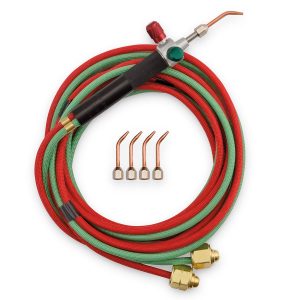
Why Smith Delivers the Lowest TCO Worldwide
- Exceptional Durability – Materials, machining, and QC built for decades.
- Industry-Leading Warranty – Up to 25 years parts & labor coverage.
- High Reliability – Consistent flame and pressure control.
- Reduced Maintenance Burden – Simple cleaning, robust seals.
- Lower Downtime – Fewer failures = higher uptime.
- Safety Performance – Tip-mix design minimizes flashback probability.
- Global Support – Backed by Miller Electric’s distribution and service network.
- Predictable Economics – Warranty starts at end-user delivery, ensuring full value.
- Compatibility – Genuine Smith tips retain performance and warranty.
- Long-Term Brand Stability – A century of continuous production heritage.
Key Takeaways for Decision Makers
| Factor | Low-Cost Brand | Smith Oxyfuel |
|---|---|---|
| Initial Cost | Low | Moderate |
| Durability | 2–3 years | 15–25 years |
| Warranty | 1-year avg | Up to 25 years |
| Downtime Risk | High | Very Low |
| Maintenance | High | Minimal |
| Support Network | Limited | Global (Miller) |
| 10-yr TCO | $4,350 | $1,600 |
| 20-yr TCO | $7,900 | $2,600 |
| ROI | Negative | Positive (> 60% savings) |
| Safety Rating | Variable | Industry Best |
Example ROI Narrative
Imagine a 50-torch fleet across multiple production bays.
- 50 × (10-year savings $2,750) = $137,500 saved per decade.
- Add avoided downtime worth $15,000 per year → $150,000 more in throughput value.
- Include reduced injury risk → lower insurance premiums (~$5,000 per year).
Combined benefit ≈ $300,000 over 10 years—achieved simply by specifying Smith.
How to Communicate TCO Internally
When presenting to finance or procurement:
- Show warranty durations side by side (25 years vs 1–3).
- Quantify downtime using hourly labor rates and crew size.
- Include safety incidents as financial events.
- Highlight ESG benefits from less waste and longer product life.
- Use the 10/20-year tables as visual proof of savings.
This transforms an “expensive” purchase into a cost-avoidance investment.
The Strategic Conclusion
In oxyfuel, the cheapest equipment is rarely the least expensive to own.
When the math includes uptime, service life, and safety, Smith oxyfuel systems consistently deliver the lowest Total Cost of Ownership in the world.
- Engineers value precision and consistency.
- Production managers appreciate uptime and predictability.
- Financial controllers see measurable, multi-year savings.
- Safety leaders trust a torch line with a documented 25-year warranty and proven resistance to flashbacks.
Buy Once. Use for Decades. Spend Less Overall. That’s the real meaning of low TCO.